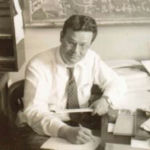
Charles D. Coryell
American chemist
Charles D. Coryell's AcademicInfluence.com Rankings

Download Badge
Chemistry
Charles D. Coryell's Degrees
- PhD Chemistry University of California, Berkeley
- Bachelors Chemistry University of California, Berkeley
Why Is Charles D. Coryell Influential?
(Suggest an Edit or Addition)According to Wikipedia, Charles DuBois Coryell was an American chemist who was one of the discoverers of the element promethium. Coryell earned a Ph.D. at California Institute of Technology in 1935 as the student of Arthur A. Noyes. During the late 1930s he engaged in research on the structure of hemoglobin in association with Linus Pauling. He also taught at UCLA before 1942. In 1942 he accepted a job with the Manhattan Project, for which he was Chief of the Fission Products Section, both at the University of Chicago and at Clinton Laboratories in Oak Ridge, Tennessee . His group had responsibility for characterizing radioactive isotopes created by the fission of uranium and for developing a process for chemical separation of plutonium.
Charles D. Coryell's Published Works
Published Works
- The Magnetic Properties and Structure of Hemoglobin, Oxyhemoglobin and Carbonmonoxyhemoglobin (1936) (962)
- Radiochemical studies : the fission products (1951) (246)
- A procedure for geochemical interpretation of terrestrial rare-earth abundance patterns (1963) (224)
- The Magnetic Properties and Structure of the Hemochromogens and Related Substances (1936) (183)
- The Magnetic Properties and Structure of Ferrihemoglobin (Methemoglobin) and Some of its Compounds (1937) (153)
- FERRITIN III. THE MAGNETIC PROPERTIES OF FERRITIN AND SOME OTHER COLLOIDAL FERRIC COMPOUNDS (1943) (108)
- The Science and Engineering of Nuclear Power (1947) (104)
- The chemical identification of radioisotopes of neodymium and of element 61. (1947) (86)
- SEARCH FOR CORRELATIONS OF MOST PROBABLE NUCLEAR CHARGE ZP OF PRIMARY FISSION FRAGMENTS WITH COMPOSITION AND EXCITATION ENERGY (1961) (67)
- Ratios of Independent Yields of the Isomers Te-131-131m and Te-133-133m in Fission (1965) (60)
- The Magnetic Properties of Intermediates in the Reactions of Hemoglobin. (1939) (51)
- A STRUCTURAL INTERPRETATION OF THE ACIDITY OF GROUPS ASSOCIATED WITH THE HEMES OF HEMOGLOBIN AND HEMOGLOBIN DERIVATIVES (1940) (49)
- beta-Decay Energetics (1953) (48)
- The Magnetic Susceptibility of the Iron in Ferrohemoglobin (1938) (43)
- Argentic Salts in Acid Solution. V. Oxidation Potentials, Equilibria with Higher Silver Oxides, and Formation of Nitrate Complexes1 (1937) (42)
- Lanthanum, Europium, and Dysprosium Distributions in Igneous Rocks and Minerals (1963) (42)
- ELECTROMIGRATION IN A CATION-EXCHANGE RESIN. III. CORRELATION OF SELF- DIFFUSION COEFFICIENTS OF IONS IN A CATION-EXCHANGE MEMBRANE TO ITS ELECTRICAL CONDUCTANCE (1953) (38)
- Decay Schemes of 43-DayCd115mand 2.3-DayCd115g (1966) (38)
- The Existence of Chemical Interactions between the Hemes in Ferrihemoglobin (Methemoglobin) and the Role of Interactions in the Interpretation of Ferro–Ferrihemoglobin Electrode Potential Measurements. (1939) (38)
- SHORT-LIVED ISOTOPES OF Pd AND Ag OF MASSES 113-117 (1958) (36)
- Electromigration in a Cation Exchange Resin. II. Detailed Analysis of Two-Component Systems (1952) (30)
- Magnetic Studies of Ferrihemoglobin Reactions. II. Equilibria and Compounds with Azide Ion, Ammonia, and Ethanol1 (1940) (28)
- DISTRIBUTION OF ZIRCONIUM AND HAFNIUM BETWEEN CATION-EXCHANGE RESIN AND ACID SOLUTIONS. THE COLUMN SEPARATION WITH NITRIC ACID-CITRIC ACID MIXTURE (1954) (28)
- Fission Yield Fine Structure in the Mass Region 99-106 (1954) (27)
- Argentic Salts in Acid Solution. IV. The Kinetics of the Reduction by Water and the Formation by Ozone of Argentic Silver in Nitric Acid Solution1 (1937) (25)
- LOW-ENERGY PHOTOFISSION YIELDS FOR U$sup 23$$sup 8$ (1954) (24)
- Electromigration in a cation exchange resin. (1951) (21)
- The Magnetic Study of the Equilibrium between Ferrohemoglobin, Cyanide Ion, and Cyanide Ferrohemoglobin (1939) (21)
- THE PROPOSED TERMS "EXERGONIC" AND "ENDERGONIC" FOR THERMODYNAMICS. (1940) (19)
- Manhattan Project: The Untold story of the Making of the Atomic Bomb (1968) (18)
- The decay of 1.2 min 113mAg and 5.3 h 113gAg (1969) (18)
- S 81. The electron transfer (exchange) between cobaltous and cobaltic amine complexes (1949) (17)
- Nuclear Charge Distribution in the Fission of Uranium and Thorium with 13.6-Mev Deuterons (1957) (17)
- Decay of 54-sec Br86 and 55-sec Br87 (1966) (17)
- Characterization ofRu107,Ru108,Rh107, andRh108 (1962) (16)
- Decay Properties of 74-SecondAg111m (1957) (15)
- The chemistry of creation of the heavy elements (1961) (15)
- The γ-ray spectrum of short-lived fission-product bromine isotopes and the decay scheme of 3·0-min 85Br (1971) (13)
- Half life of 135Sb and evidence on the half life of 134Sb (1964) (13)
- Identification and characterization of 3.8 min 134mI (1972) (11)
- The Magnetic Properties and Structure of Manganous and Cobaltous Dipyridine Chlorides (1938) (11)
- The decay of 20 min 115gAg (1970) (11)
- The periodic table: The 6d-5f mixed transition group (1952) (9)
- Investigations on the Stereoisomerism of Unsaturated Compounds. IV. The Identification ofcis-transIsomers by Rate Studies (1939) (9)
- Decay of 45 sec and 83 sec 136I isomers (1971) (9)
- The Reduction Potential of Vanadic Acid to Vanadyl Ion in Hydrochloric Acid Solutions (1933) (9)
- DECAY OF Cd$sup 119$ AND In$sup 119$ ISOMERS (1961) (9)
- Preparation and Half-Life ofCr55 (1954) (8)
- Quantitative Investigations of Amino Acids and Peptides. XIV. Equilibria between Amino Acids and Formaldehyde: Arginine and Lysine. (1943) (8)
- DECAY OF 20-MINUTE Ag$sup 11$$sup 5$ (1964) (7)
- The neutron activation of chlorates and perchlorates and the preparation of 38ClO3− and 38ClO4− (1965) (7)
- DECAY OF 13.2-h /sup 87m/Y, 80.3-h /sup 87g/Y, AND 2.83-h /sup 87m/Sr. (1969) (6)
- The Diamagnetism of Gaseous Nitrosyl Chloride (1938) (6)
- The Thermodynamic Constants of the Dithionite (Hydrosulfite) Ion (1942) (6)
- Radiochemical study of the separation of lanthanum from barium by cation exchanger: Genetic study of Ba140—La140 and a La140 reservoir (1955) (6)
- The Distribution of Nuclear Charge in Fission (1948) (5)
- Radiations from 83 min 139Ba (1961) (5)
- RADIOACTIVE DECAY OF 23-MIN $sup 131$Sb TO LEVELS OF $sup 131$Te. (1971) (5)
- Quantitative Investigations of Amino Acids and Peptides. XIII. Equilibria between Histidine and Formaldehyde. (1943) (5)
- Studies of Weak β ̄ -Transitions in 95Zr⃗95Nb⃗95Mo Chain (1972) (4)
- The Distribution of Lithium Chloride and Tracer Lithium Bromide between Aqueous Lithium Chloride Solution and Benzene Solution of a Quaternary Ammonium Chloride (1966) (4)
- The acceptance of new official names for the elements (1950) (4)
- Quantitative Investigations of Amino Acids and Peptides. VII. Equilibria between Amino Acids and Formaldehyde (1942) (3)
- The Hammett acidity function H0 in H2SO4SO3 mixtures; superacidity (1955) (3)
- Quantitative Investigations of Amino Acids and Peptides. X. Equilibria between Amino Acids and Formaldehyde: Leucine and N-Methylleucine. (1943) (3)
- Yields of Krypton Isotopes from the Deuteron and Alpha Bombardment of Heavy Nuclei (1961) (3)
- Isomeric-yield ratios of 117Cd in the (n, γ) and (d, p) reactions (1973) (3)
- DECAY OF 284-DAY $sup 144$Ce, 17.3-MIN $sup 144$Pr, AND A NEW ISOMER, 7.2- MIN /sup 144m/Pr. (1970) (2)
- ABSENCE OF SPECIES OTHER THAN $sup 87$Br CONTRIBUTING TO THE 55.4-SEC DELAYED NEUTRON ACTIVITY IN FISSION (1966) (1)
- The Fast Chloride Exchange between Hydrochloric Acid and Chloroauric Acid in β,β′-Dichlorodiethyl Ether (1956) (1)
- Quantitative Investigations of Amino Acids and Peptides. XI. Equilibria between Amino Acids and Formaldehyde: Glutamic Acid. (1943) (1)
- Models for nuclear structure of spherical nuclei (1967) (1)
- CHARGE DISTRIBUTION IN NUCLEAR FISSION: STUDIES EITH ENERGY DEPOSIT OF ABOUT 22 Mev (1962) (1)
- Teaching radiochemistry at Massachusetts Institute of Technology (1951) (1)
- SECTION OF PHYSICS AND CHEMISTRY: BETA‐DECAY ENERGETICS AND NUCLEAR SHELL STRUCTURE* (1953) (1)
- STUDY OF THE RADIATIONS FROM Br-87 (1962) (0)
- Fission product chains and fission yields (1945) (0)
- RADIOCHEMICAL STUDIES OF LOW-LYING OPPOSITE PARITY STATES IN VIBRATIONAL AND TRANSITIONAL NUCLEI. (1969) (0)
- The gram electron (1942) (0)
- The scientific importance of the nuclear power projects. (1946) (0)
- The Radioactive Decay of K$sup 4$$sup 0$ (1948) (0)
- A Comparison of Gross Fission Product Decay with Decay of the Sum of the Separated Fission Products (1949) (0)
- PROBABLE ABSENCE OF K CAPTURE IN THE DECAY OF LEAD-205 (1956) (0)
- A CONSIDERATION OF THE VARIATION OF NUCLEAR CHARGE AMONG THE PRIMARY FISSION PRODUCTS (1946) (0)
- The Scientific and Social Significance of the Atomic Energy Projects (1948) (0)
- THE PLACE OF THE SYNTHETIC ELEMENTS IN THE PERIODIC SYSTEM (1951) (0)
- The Relationship between the Range and Spectrograph Energy of /cap beta/- Particles (1949) (0)
- CHEMICAL CONSEQUENCES OF BETA DECAY OF CERIUM AS THE ACETYLACETONATE (1961) (0)
- Progress in Nuclear Physics and Annual Review of Nuclear Science Vol. 2 (1954) (0)
- The Proposed Terms "Exergonic" and "Endergonic" for Thermodynamics (1940) (0)
- The Reduction Potential of Pentavalent Vanadium to Vanadyl Ion in Hydrochloric Acid Solutions. Fluoresenzversuch AnOrganische Daempfe, Besonders Aceton. Studies of the Nature and Reactions of Oxidized Silver Compounds, Especially in Nitric Acid (1935) (0)
- NUCLEAR CHEMISTRY (INORGANIC) GROUP, sect. 5 of PROGRESS REPORT NINETEENTH, FOR FOURTH QUARTER OF 1950 (1951) (0)
- TIME VARIATION OF PERCENT DISTRIBUTION OF FISSION ACTIVITY IN BOMBARDED URANYL NITRATE (1943) (0)
- Studies of weak $beta$$sup -$-transitions in $sup 95$Zr $Yields$ $sup 95$Nb $Yields$ $sup 95$Mo chain. (1972) (0)
- Generalized Acidity in Radiochemical Separations (1956) (0)
- Of Whom the Book Told (1968) (0)
- CHEMICAL RESEARCH--RADIOCHEMISTRY REPORT FOR MONTH ENDING APRIL 17, 1943 (1952) (0)
- Yields of Plutonium from Cyclotron Neutrons in Various Uranium Containing Media (1945) (0)
This paper list is powered by the following services:

Other Resources About Charles D. Coryell
What Schools Are Affiliated With Charles D. Coryell?
Charles D. Coryell is affiliated with the following schools:
