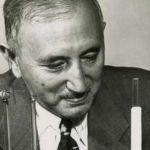
David Wechsler
#6,657
Most Influential Person Across History
American psychologist and academic
David Wechsler's AcademicInfluence.com Rankings

Download Badge
Psychology
David Wechsler's Degrees
- PhD Psychology Columbia University
Why Is David Wechsler Influential?
(Suggest an Edit or Addition)According to Wikipedia, David Wechsler was a Romanian-American psychologist. He developed well-known intelligence scales, such as the Wechsler Adult Intelligence Scale and the Wechsler Intelligence Scale for Children to get to know his patients at Bellevue Hospital. A Review of General Psychology survey, published in 2002, ranked Wechsler as the 51st most cited psychologist of the 20th century.
David Wechsler's Published Works
Number of citations in a given year to any of this author's works
Total number of citations to an author for the works they published in a given year. This highlights publication of the most important work(s) by the author
Published Works
- Manual for the Wechsler Adult Intelligence Scale. (1955) (5574)
- A Standardized Memory Scale for Clinical Use (1945) (3027)
- Manual for the Wechsler intelligence scale for children (1974) (2047)
- The measurement and appraisal of adult intelligence, 4th ed. (1958) (1812)
- WAIS-R manual : Wechsler adult intelligence scale-revised (1981) (1575)
- Manual of the Wechsler Intelligence Scale for Children-Revised (1974) (1241)
- The Measurement Of Adult Intelligence (1952) (1240)
- The measurement of adult intelligence, 3rd ed. (1941) (782)
- Wechsler's Measurement and Appraisal of Adult Intelligence (1972) (746)
- Manual for the Wechsler preschool and primary scale of intelligence (1967) (745)
- Wechsler Intelligence Scale for Children; manual. (1949) (540)
- Non-intellective factors in general intelligence. (1943) (332)
- Cognitive, conative, and non-intellective intelligence. (1950) (212)
- The psychometric tradition: Developing the wechsler adult intelligence scale☆ (1981) (207)
- Intelligence Defined and Undefined: A Relativistic Appraisal. (1975) (136)
- The Attitudes of Children toward Death (1934) (106)
- The Cornell Index: A Method for Quickly Assaying Personality and Psychosomatic Disturbances, to be Used as an Adjunct to Interview (1946) (36)
- The effect of alcohol on mental activity. (1941) (34)
- Intellectual development and psychological maturity. (1950) (33)
- The Range of Human Capacities (1936) (33)
- The Relation of Personality Disturbances to Duration of Convalescence from Acute Respiratory Infections* (1947) (31)
- Personality and Psychosomatic Disturbances in Patients on Medical and Surgical Wards: A Survey of 450 Admissions* (1945) (31)
- THE CORNELL SELECTEE INDEX: A METHOD FOR QUICK TESTING OF SELECTEES FOR THE ARMED FORCES (1944) (30)
- The Problem of Axial Rotation in Reading Disability (1964) (29)
- Sex and Personality (1937) (27)
- Equivalent test and mental ages for WISC. (1951) (26)
- SCHIZOPHRENIC PATTERNS ON THE WISC. (1965) (25)
- The Measurement of Emotional Reactions: Researches on the Psychogalvanic Reflex (1927) (25)
- Galvanometric Technique in Studies of Association (1928) (20)
- Reversal errors in reading: phenomena of axial rotation. (1937) (20)
- Selected Papers of David Wechsler (1974) (18)
- Clinical use of the mental deterioration index of the Bellevue-Wechsler scale. (1945) (16)
- Engrams, memory storage, and mnemonic coding. (1963) (14)
- The illusion of the oblique intercept (1936) (13)
- The Incidence of Personality Disturbances and their Relation to Age, Rank and Duration of Hospitalization in Patients with Medical and Surgical Disorders in a Military Hospital* (1947) (13)
- A Study of Emotional Specificity (1928) (13)
- THE CORNELL INDICES AND THE CORNELL WORD FORM: 2. RESULTS (1946) (13)
- The effect of electroconvulsive treatment upon the perception of the spiral aftereffect, a presumed measure of cerebral dysfunction. (1959) (11)
- La mesure de l'intelligence de l'adulte (1960) (11)
- Galvanic Responses of Preschool Children (1930) (10)
- Analytic use of the Army Alpha. (1932) (9)
- The psychologist in the psychiatric hospital. (1944) (9)
- THE RELATIVE EFFECTIVENESS OF THE STANFORD‐BINET AND THE BELLEVUE INTELLIGENCE SCALE IN DIAGNOSING MENTAL DEFICIENCY* (1939) (9)
- On the Specificity of Emotional Reactions (1925) (8)
- On the influence of education on intelligence as measured by the Binet-Simon tests. (7)
- Sex Differences in Intelligence. (1958) (7)
- What constitutes an emotion (6)
- The burden of age. (1935) (4)
- FURTHER COMMENT ON THE PSYCHOLOGICAL SIGNIFICANCE OF THE GALVANIC REACTION (1925) (4)
- Rorschach's Test III--Advances in Interpretation. (1953) (3)
- Psychometric study of insulin-treated schizophrenics (1940) (3)
- Selection and description of tests. (1939) (3)
- The clinical measurement of anxiety (1945) (3)
- An apparatus for measuring reaction times without a chronoscope. (1926) (3)
- The Classification of Intelligence. (1944) (3)
- The concept of mental deficiency in theory and practice (1935) (3)
- Need for an Adult Intelligence Scale. (1941) (3)
- The Concepts of Mental Age and Intelligence Quotient. (1944) (2)
- Your Personality is in Your Hands. (1960) (2)
- Note on the Correlation between Chronaxie and Reaction Time (1932) (2)
- Mental Deterioration and Its Appraisal. (1958) (2)
- Basic Data and Test Results. (1958) (2)
- Concept of mental deficiency. (1939) (2)
- DIVISION OF PSYCHOLOGY: INTELLIGENCE, QUANTUM RESONANCE AND THINKING MACHINES* (1960) (2)
- Nature of intelligence. (1939) (2)
- Factorial Composition of the Wechsler-Bellevue I and Wechsler Adult Intelligence Scales. (1958) (1)
- Psychology as a Practical Science in Modern Life (1926) (1)
- Tests of Intelligence. (1953) (1)
- Introduction--The problem. (1935) (1)
- Utilization of W-B I and WAIS in Counseling and Guidance. (1958) (1)
- Classification of intelligence. (1939) (1)
- Comment: Reply from the American Board of Examiners in Professional Psychology. (1950) (1)
- Changes in Intelligence and Intellectual Ability with Age. (1958) (1)
- Distinguished Professional Contribution Award for 1973 (1974) (1)
- Preliminary Investigation of the Visuo-Motor Recall Test (1972) (1)
- On the limits of human variability. (1932) (1)
- Historical bases for psychological tests. (1950) (1)
- STUDIES IN CHRONAXIA: I. METHODOLOGY AND NORMAL VARIATIONS, WITH A REPORT ON THIRTY CASES IN CHILDREN (1929) (1)
- Language and Thoughts in Shizophrenia (1945) (0)
- Natural constants and the limits of human variability. (1935) (0)
- X. - The relation of ability to intelligence (1949) (0)
- The problem of mental deterioration. (1939) (0)
- Concepts of Mental Deficiency. (1958) (0)
- The Theoretical with the Practical: The Measurement of Adult Intelligence (1941) (0)
- Conformity and the Idea of Being Well Born. (1961) (0)
- Concept of mental age and IQ. (1939) (0)
- The meaning of differences. (1935) (0)
- Genius and deficiency. (1935) (0)
- Limitations and special merits. (1939) (0)
- Need for an adult intelligence test. (1939) (0)
- The measurement of human capacities. (1935) (0)
- The distribution of traits and ability. (1935) (0)
- Standardization and results. (1939) (0)
- Changes in Intelligence Consequent to Brain Damage. (1958) (0)
- Odyssey of a Fertile Mind. (1970) (0)
- The Concept of Mental Deficiency. (1944) (0)
- Population used in standardizing tests. (1939) (0)
- Populations Used in 1939 and 1955 Standardizations. (1958) (0)
- The Concept of Mental Age, IQ and Deviation Scores. (1958) (0)
- Timely and Important: The Measurement of Adult Intelligence (1942) (0)
- Diagnostic and Clinical Features. (1941) (0)
This paper list is powered by the following services:

Other Resources About David Wechsler
What Schools Are Affiliated With David Wechsler?
David Wechsler is affiliated with the following schools:
