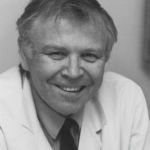
Kjell Kleppe
#35,317
Most Influential Person Across History
American reproductive biologist
Kjell Kleppe's AcademicInfluence.com Rankings

Download Badge
Biology
Kjell Kleppe's Degrees
- PhD Reproductive Biology University of California, Berkeley
- Masters Biology Stanford University
- Bachelors Biology Stanford University
Similar Degrees You Can Earn
Why Is Kjell Kleppe Influential?
(Suggest an Edit or Addition)According to Wikipedia, Kjell Kleppe was a Norwegian biochemist and molecular biologist who was a pioneer in the polymerase chain reaction technique and built the first laboratory in the country for bio- and gene technology.
Kjell Kleppe's Published Works
Number of citations in a given year to any of this author's works
Total number of citations to an author for the works they published in a given year. This highlights publication of the most important work(s) by the author
Published Works
- Studies on polynucleotides. XCVI. Repair replications of short synthetic DNA's as catalyzed by DNA polymerases. (1971) (367)
- THE OXIDATION OF GLUCOSE AND RELATED COMPOUNDS BY GLUCOSE OXIDASE FROM ASPERGILLUS NIGER. (1964) (230)
- Physical characterization and simultaneous purification of bacteriophage T4 induced polynucleotide kinase, polynucleotide ligase, and deoxyribonucleic acid polymerase. (1973) (195)
- Total Synthesis of the Gene for an Alanine Transfer Ribonucleic Acid from Yeast (1970) (178)
- The effect of hydrogen peroxide on glucose oxidase from Aspergillus niger. (1966) (154)
- d-amino acid oxidase II. Specificity, competitive inhibition and reaction sequence (1965) (153)
- Expression of oncogenes in thyroid tumours: coexpression of c-erbB2/neu and c-erbB. (1988) (119)
- The hydrolysis of alpha-D-glucosides by amyloglucosidase from Aspergillus niger. (1962) (119)
- D-AMINO ACID OXIDASE. I. DISSOCIATION AND RECOMBINATION OF THE HOLOENZYME. (1965) (107)
- Chromosome Damage and Repair (1981) (93)
- Effect of salts and polyamines on T4 polynucleotide kinase. (1975) (92)
- A glycoprotein structure for glucose oxidase from Aspergillus niger. (1965) (89)
- Reversal of bacteriophage T4 induced polynucleotide kinase action. (1973) (88)
- THE GLYCOPROTEIN NATURE OF SOME FUNGAL CARBOHYDRASES. (1963) (78)
- Phosphorylation of double-stranded DNAs by T4 polynucleotide kinase. (1976) (73)
- Polynucleotide ligase-catalyzed joining of deoxyribo-oligonucleotides on ribopolynucleotide templates and of ribo-oligonucleotides on deoxyribopolynucleotide templates. (1970) (71)
- Kinetics and specificity of T4 polynucleotide kinase. (1975) (61)
- Optimal conditions for hybridization with oligonucleotides: a study with myc-oncogene DNA probes. (1988) (51)
- Total synthesis of the structural gene for the precursor of a tyrosine suppressor transfer RNA from Escherichia coli. 1. General introduction. (1976) (50)
- Polyamine induced aggregation of DNA. (1977) (47)
- Applications of magnetic beads with covalently attached oligonucleotides in hybridization: isolation and detection of specific measles virus mRNA from a crude cell lysate. (1990) (44)
- The application of density-gradient centrifugation for the isolation of enzymes. (1962) (44)
- The effect of caffeine on cell growth and metabolism of thymidine in Escherichia coli. (1980) (43)
- Cloning and sequencing of the gene for the DNA-binding 17 K protein of Escherichia coli (1988) (41)
- Polyamine-induced hydrolysis of apurinic sites in DNA and nucleosomes. (1982) (41)
- Kinetics and effect of salts and polyamines on T4 polynucleotide ligase. (1975) (40)
- The bacterial nucleoid. (1979) (37)
- Effect of ionic strength, pH, amines and divalent cations on the lytic activity of T4 lysozyme. (1972) (35)
- Affinity of protein HU for different nucleic acids (1985) (34)
- d-Amino acid oxidase III. Effect of pH (1965) (33)
- Studies on T4 lysozyme. Affinity for chitin and the use of chitin in the purification of the enzyme. (1972) (30)
- Envelope-associated folded chromosomes for Escherichia coli: variations under different physiological conditions (1976) (29)
- Aspartate transcarbamylase from Escherichia coli I. Inhibition by inorganic anions (1966) (29)
- Purification and characterization of the 17 K protein, a DNA-binding protein from Escherichia coli. (1987) (28)
- Studies on the SH groups of phosphorylase b. Reaction with 5,5'-dithiobis-(2-nitrobenzoic acid). (1969) (25)
- Identity of the 17-kilodalton protein, a DNA-binding protein from Escherichia coli, and the firA gene product (1988) (24)
- Properties and Mechanism of Action of Eukaryotic 3-Methyladenine-DNA Glycosylases (1987) (24)
- Isolation, properties and nucleolytic degradation of chromatin from Escherichia coli. (1982) (23)
- DNA- and RNA-binding proteins of chromatin from Escherichia coli. (1987) (22)
- Reaction of biological thiols with the tumor inhibitor jatrophone. Inhibition of RNA polymerase. (1973) (21)
- The reactivity of SH groups in phosphorylase b. (1966) (20)
- Preparation and separation of d(pT)-10-n oligonucleotides. (1975) (18)
- Substrate specificity of 3-methyladenine-DNA glycosylase from calf thymus. (1987) (18)
- The number of SH groups in rabbit muscle phosphorylase. (1967) (17)
- Studies on polynucleotides. 103. Total synthesis of the structural gene for an alanine transfer ribonucleic acid from yeast. (1972) (17)
- Purification and characterization of 3-methyladenine-DNA glycosylase from calf thymus. (1985) (16)
- CXV. Total synthesis of the structural gene for an alanine transfer RNA from yeast. Enzymic joining to form the total DNA duplex. (1972) (15)
- Effect of caffeine on DNA polymerase I from Escherichia coli: studies in vitro and in vivo. (1978) (15)
- Purification and properties of 3-methyladenine-DNA glycosylase from L-cells. (1981) (15)
- Cloning and sequencing of the gene for the DNA-binding 17K protein of Escherichia coli. (1988) (14)
- Pyrimidine Metabolism in Acinetobacter calcoaceticus (1973) (14)
- Effect of polyamines on enzymes involved in DNA repair. (1981) (14)
- The synthesis of thymidine diphosphate hexoses of Streptococcus faecalis grown on D-galactose. (1962) (13)
- Phosphorylation of tRNA by T4 polynucleotide kinase. (1977) (13)
- Mechanism of inhibition of thymidine kinase from Escherichia coli by caffeine (1980) (11)
- Preferential inactivation of the allosteric function of aspartate transcarbamylase by x-rays. (1966) (11)
- Properties of a DNA repair endonuclease from mouse plasmacytoma cells. (1985) (11)
- Mammalian DNA‐repair endonuclease acts only on supercoiled DNA (1982) (11)
- Separation of damage specific DNA endonuclease activities present in calf thymus (1987) (10)
- Feedback inhibition and ionizing radiation. Mechanism of inactivation of allosteric properties of aspartate transcarbamylase by X-rays. (1967) (10)
- Characterization of the DNA-cellulose-binding proteins from Escherichia coli K 12. (1983) (10)
- Total synthesis of the structural gene for the precursor of a tyrosine suppressor transfer RNA from Escherichia coli. 11. Enzymatic joining to form the total DNA duplex. (1976) (10)
- Effect of methyl methanesulphonate on the nucleoid structure of Escherichia coli. (1981) (9)
- Influence of polyamines on the activity of DNA polymerase I from Escherichia coli. (1978) (8)
- Aspartate transcarbamylase from Escherichia coli. II. Interaction of metal ions with substrates, inhibitors and activators. (1966) (8)
- Study on polynucleotideCXIII. Total synthesis of the structural gene for an alanine transfer RNA from yeast. Enzymic joining of the chemically synthesized segments to form the DNA duplex corresponding to nucleotide sequence 17 to 50 (1972) (7)
- Polynucleotide kinase. (1979) (7)
- Xeroderma pigmentosum: in vitro complementation of DNA repair endonuclease. (1984) (7)
- Action of a mammalian AP-endonuclease on DNAs of defined sequences. (1989) (7)
- INORGANIC PYROPHOSPHATE AND CELLULAR CONTROL MECHANISMS: INHIBITION OF ASPARTATE TRANSCARBAMYLASE. (1965) (7)
- Preparations and properties of ribonucleic acid polymerase from Acinetobacter calcoaceticus (1976) (6)
- Analysis of cleavage products of DNA repair enzymes and other nucleases. Characterization of an apurinic/apyrimidinic specific endonuclease from mouse plasmacytoma cells. (1988) (6)
- Development of the nitrocellulose filter technique for RNA-DNA hybridization (1980) (5)
- Multiple DNA polymerases in Acinetobacter calcoaceticus (1974) (5)
- Mitomycin-C-induced changes in the nucleoid of Escherichia coli K12. (1983) (4)
- Effect of pH on incorporation of ribonucleotides into DNA by DNA polymerase I (1974) (4)
- Proteins Associated with Chromatin from Escherichia coli (1986) (4)
- Effect of caffeine on nucleotide pools in Escherichia coli. (1982) (4)
- DNA polymerase I from Acinetobacter calcoaceticus: enzymatic properties. (1974) (4)
- Total synthesis of the structural gene for the precursor of a tyrosine suppressor transfer RNA from Escherichia coli. 10. Enzymatic joining of chemically synthesized segments to form the DNA duplex corresponding to the nucleotide sequence 86-126. (1976) (4)
- T4 polynucleotide ligase catalyzed joining on triple-stranded nucleic acids. (1978) (3)
- The structure of the bacterial nucleoid. (1984) (3)
- PURIFICATION AND PROPERTIES OF A GLUCOSE OXIDASE FROM ASPERGILLUS NIGER (1963) (3)
- Two-dimensional gel electrophoretic separation of the proteins present in chromatin of Escherichia coli. (1984) (3)
- D-AMINO ACID OXIDASE. 3. EFFECT OF PH. (1965) (3)
- Changes in polypeptide synthesis and glycosylation in mouse embryonic fibroblast C3H/10T1/2 Cl 8 cells caused by the tumor promoter 12-O-tetradecanoylphorbol 13-acetate. (1986) (3)
- Effect of ATP analogues on T4 polynucleotide ligase. (1978) (3)
- Influence of Alkylating Agents on the Structure of the Bacterial Nucleoid (1981) (2)
- Total synthesis of the structural gene for the precursor of a tyrosine suppressor transfer RNA from Escherichia coli. 9. Enzymatic joining of chemically synthesized deoxyribopolynucleotide segments corresponding to nucleotide sequence 57-94. (1976) (2)
- Properties of enzymes that recognize modified structures in DNA (1984) (1)
- 113. Total synthesis of the structural gene for an alanine transfer RNA from yeast. Enzymic joining of the chemically synthesized segments to form the DNA duplex corresponding to nucleotide sequence 17 to 50. (1972) (1)
This paper list is powered by the following services:


Other Resources About Kjell Kleppe
What Schools Are Affiliated With Kjell Kleppe?
Kjell Kleppe is affiliated with the following schools:
