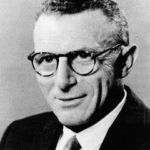
Max Tishler
#23,988
Most Influential Person Across History
American chemist
Max Tishler's AcademicInfluence.com Rankings

Download Badge
Chemistry
Why Is Max Tishler Influential?
(Suggest an Edit or Addition)According to Wikipedia, Max Tishler was president of Merck Sharp and Dohme Research Laboratories where he led the research teams that synthesized ascorbic acid, riboflavin, cortisone, pyridoxine, pantothenic acid, nicotinamide, methionine, threonine, and tryptophan. He also developed the fermentation processes for actinomycin, vitamin B12, streptomycin, and penicillin. Tishler invented sulfaquinoxaline for the treatment for coccidiosis.
Max Tishler's Published Works
Number of citations in a given year to any of this author's works
Total number of citations to an author for the works they published in a given year. This highlights publication of the most important work(s) by the author
Published Works
- Hydro, oxido and other derivatives of vitamin K1 and related compounds. (1940) (143)
- The Preparation of Cyclic Ketones by Ring Enlargement (1939) (80)
- VITAMIN K ACTIVITY AND STRUCTURE (1941) (67)
- Synthesis and Structure of Steroidal Pregn-4-eno- and 5α-Pregnano [3,2-c]pyrazoles. A Novel Class of Potent Anti-Inflammatory Steroids (1964) (65)
- Preparation of the Stereoisomeric α,β-Diphenyl-β-hydroxyethylamines (1951) (64)
- The reaction between o-aminoazo compounds and barbituric acid; a new synthesis of riboflavin. (1947) (61)
- Synthesis and Structure of Steroidal 4-Pregneno [3,2-c]Pyrazoles. A Novel Class of Potent Anti-Inflammatory Steroids (1963) (50)
- Synthesis of DL-methionine. (1948) (49)
- THE CHEMICAL NATURE OF ACTINOMYCIN, AN ANTI-MICROBIAL SUBSTANCE PRODUCED BY ACTINOMYCES ANTIBIOTICUS (1942) (48)
- Some New Aminopyrazines and their Sulfanilamide Derivatives (1945) (43)
- Mold metabolites; isolation of several compounds from clinical penicillin. (1948) (41)
- Relationship of structures and microbiological activities of the 16-membered macrolides. (1972) (39)
- Identification of mycolutein and pulvomycin as aureothin and labilomycin respectively. (1976) (35)
- Total syntheses of (.+-.)-cerulenin, (.+-.)-tetrahydrocerulenin and related compounds (1982) (35)
- Improved Syntheses of Indole-3-aldehyde (1946) (35)
- 16-Methylated Steroids. IV. 6,16α-Dimethyl-▵6-Hydrocortisone and Related Compounds (1963) (34)
- The Preparation of Δ7,9(11)-allo-Steroids by the Action of Mercuric Acetate on Δ7-allo-Steroids (1953) (34)
- The challenge ahead. (1966) (31)
- The Synthesis of Pteroylglutamic Acid (1955) (31)
- The Application of a New Alkylation Reaction to the Synthesis of Tryptophan (1945) (30)
- A NEW BIOLOGICALLY POTENT STEROID: 1-DEHYDRO-9α-FLUOROHYDROCORTISONE ACETATE (1955) (28)
- Agaridoxin, a mushroom metabolite. Isolation, structure, and synthesis. (1976) (25)
- THE EFFECT OF CYSTEINE ON STREPTOMYCIN AND STREPTOTHRICIN. (1945) (25)
- The oxidation of β-carotene. (1950) (24)
- The Conversion of Cholic Acid into 3α-Hydroxy-12-keto-Δ9(11)-cholenic Acid (1951) (22)
- Structure of prumycin. (1974) (22)
- The Antiriboflavin Effect of Isoriboflavin.∗ (1944) (21)
- SYNTHESIS OF 11-KETO STEROIDS (1951) (20)
- Nature of the By-product in the Synthesis of Vitamin K1 (1940) (20)
- Steroid 17(α)-Acetates* (1952) (19)
- SYNTHESIS OF PREGN-4-ENO(3,2-C)PYRAZOLES RELATED TO 9-ALPHA-FLUORO-16-ALPHA-METHYLCORTISOL. (1964) (19)
- The Preparation of Riboflavin.1 III. The Synthesis of Alloxazines and Isoalloxazines (1945) (19)
- A total synthesis of -cerulenin and -tetrahydrocerulenin (1977) (19)
- Δ4-9-Methyloctalin-3,8-dione (1951) (18)
- Synthesis of 11-Hydroxylated Cortical Steroids. The Preferential Reduction of Carbonyl Systems in the Presence of Carbon—Nitrogen Multiple Bonds (1951) (18)
- The Preparation of Some Fully Acetylated Aldonic Acids and Nitriles1 (1944) (18)
- SYNTHESIS OF PHOSPHOMETHIONINE AND RELATED COMPOUNDS (1982) (17)
- The Reaction between Organic Magnesium Compounds and Alpha Bromo Ketones. II (1935) (17)
- Extensions of the Vitamin K1 Synthesis (1940) (17)
- BISMETHYLENEDIOXY STEROIDS. II. SYNTHESIS OF 9a-METHYLHYDROCORTISONE AND 9a-METHYLPREDNISOLONE (1958) (17)
- The Resolution of an Allenic Compound (1935) (16)
- Sulfaquinoxaline and Some Related Compounds (1944) (16)
- Interrelation of α-Tocopherol and α-Tocopherylquinone (1941) (15)
- The Structure of the Metallic Derivatives Which Are Formed by Adding Grignard Reagents to Unsaturated Ketones (1935) (15)
- Sulfaquinoxaline. II. A New Synthesis of 2-Aminoquinoxaline1 (1951) (15)
- Isolation of Vitamin K2 from Cultures of a Spore-Forming Soil Bacillus (1948) (14)
- The Synthesis of 11-Hydroxylated Cortical Steroids. 17-Hydroxycorticosterone1 (1950) (14)
- ANTIHEMORRHAGIC ACTIVITY OF SIMPLE COMPOUNDS (1939) (13)
- 3,4-Dihydro-3-keto-4,6,7-trimethyl-2-quinoxalinecarboxylic acid. (1947) (13)
- Benzotriazines. II. Synthesis of 3-Amino-7-halo-1,2,4-benzotriazine-1-oxides (1954) (12)
- Enol-keto tautomerism of α-ketophosphonates (1981) (11)
- Synthesis of 2'-(2,4-Difluorophenyl)-11β,17,21-trihydroxy-6,16α-dimethyl-20- oxopregna-4,6-dieno[3,2-c]pyrazole (1964) (11)
- Solitary pulmonary metastasis of choroidal malignant melanoma simulating primary lung cancer. (1986) (11)
- Chemistry of Leucomycins. XII. Application of the Modified Polonovski Reaction to Leucomycin-A3 N-Oxide (1976) (10)
- SOME PROPERTIES OF GRAMICIDIN (1941) (10)
- In an era of change. (1966) (10)
- The Transformation of Manogenin to Hecogenin1 (1952) (10)
- Synthesis of Δ1-Allopregnene-17α,21-diol-3,11,20-trione-21-acetate (1952) (10)
- SYNTHESIS OF VITAMIN A (1949) (10)
- The mechanism of prumycin action. (1974) (9)
- Hydroxy Furans. I. Beta Hydroxy Triphenylfuran (1936) (9)
- Quinoxaline-2-thiol and Derivatives (1954) (9)
- Drug research--whence and whither. (1966) (9)
- ON THE SYNTHESIS OF CORTISONE ACETATE (1951) (8)
- Drug discovery‐background and foreground (1973) (7)
- Some New Choline Type Thiols (1951) (7)
- Molecular Modification in Modern Drug Research (1964) (7)
- THE REACTION BETWEEN ORGANIC MAGNESIUM HALIDES AND ALPHA-BROMO KETONES (1932) (6)
- Further compounds having anti-hemorrhagic activity. (1940) (6)
- α-Methoxycrotonic Acid (1945) (6)
- Structure of prumycin, a 2,5-diamino-2,5-dideoxypentose-containing antibiotic (1972) (6)
- Resolution of DL-Tryptophan (1949) (5)
- Hepatitis and measles. (1983) (5)
- Hydroxylation of Δ17-20-Cyanopregnenes by Potassium Permanganate (1955) (5)
- Bismethylenedioxy Steroids. VI. Synthesis of 9α-Methylhydrocortisone and 9α-Methylprednisolone1,2 (1961) (5)
- Crystalline Salts of Dihydrostreptomycin. (1949) (5)
- VITAMIN E ACTIVITIES OF SOME COMPOUNDS RELATED TO α-TOCOPHEROL (1941) (4)
- THE SYNTHESIS OF D,L‐PHOSPHOTRYPTOPHAN (1984) (4)
- The siege of the house of reason. (1969) (4)
- AMMONIA PLANTS: Ready for 3000 tons a day (1971) (4)
- Interconversion of Adrenal Cortical Side Chains. The Transformation of Cortisone and Hydrocortisone to Corticosterone (1954) (4)
- The Synthesis of Isomethadone (1952) (3)
- THE SYNTHESIS AND BIOLOGICAL ACTIVITY OF S-ALKYL PHOSPHOHOMOCYSTEINE SULFOXIMIDES (1989) (3)
- Vitamin K activity of certain naphthols and tetralones. (1940) (3)
- Synthetic applications and mechanism of the pyrolysis of phenothiazine carbamates (1980) (3)
- The synthesis of d1-methionine. (1946) (3)
- Improved Synthesis of Biocytin (1954) (3)
- Preparation of N-(d-Ribityl)-3,4-dimethylaniline (1944) (3)
- The Decarboxylation of Opianic Acid (1947) (3)
- Displacement chlorination of dimethylaminopropanol-2. (1949) (3)
- AGARIDOXIN, A MUSHROOM METABOLITE. ISOLATION, STRUCTURE, AND SYNTHESIS (1976) (2)
- Pantothenic Acid Salts (1954) (2)
- Synthesis of Pregn-4-eno[3,2-c]pyrazoles Related to 9α-Fluoro-16α-methylcortisol 1 (1964) (1)
- SYNTHESIS OF 11-HYDROXYLATED CORTICAL STEROIDS. 17(α)-HYDROXYCORTICOSTERONE (1950) (1)
- Enol-keto tautomerism of a-ketophosphonates ( 31 P NMR / carbene insertion ) (1)
- ‘Secrets of high moment’ (1969) (1)
- Agaridoxin: A fungal catecholamine which acts as an alpha 1 agonist of mammalian hypothalamic adenylate cyclase (1982) (1)
- Preparation of 2-Methyl-3-n-hexadecyl-1,4-naphthoquinone (1941) (1)
- Impact of research on the growth of medicinal chemistry (1960) (1)
- CHEMISTRY OF LEUCOMYCINS. XII. APPLICATION OF THE MODIFIED POLONOVSKI REACTION TO LEUCOMYCIN A3 N-OXIDE (1976) (1)
- Decreased calcium content in patients with digoxin intoxication. (1979) (1)
- 2-(4-Homosulfanilamido)-quinoxaline (1946) (1)
- The public stake in medical research. (1968) (1)
- How many really care (1971) (0)
- Amino acid solution and process for preparing the same. No. 2,457,820. (1949) (0)
- SYNTHESIS OF 2'-(2,4-DIFLUOROPHENYL )-11-BETA, 17,21-TRIHYDROXY-6,16-ALPHA-DIMETHYL-20-OXOPREGNA-4,6-DIENO(3,2-C) PYRAZOLE. (1964) (0)
- The Debt of Discovery to Learning (1961) (0)
- Role of the drug house in biological and medical research. (1959) (0)
- Medical Research—Whose Responsibility ? (1968) (0)
- alpha-methoxycrotonic acid. (1945) (0)
- Cleavage of Trigonelline (1944) (0)
- A TOTAL SYNTHESIS OF DL-CERULENIN AND DL-TETRAHYDROCERULENIN (1977) (0)
- TO WAKEN THE VIRTUE OF A CARELESS AGE (1970) (0)
- HETEROCYCLIC DIAZO COMPOUNDS AS SYNTHONS IN ORGANIC SYNTHESIS. (REVIEW) (1980) (0)
- Preparation of the Stereoisomeric a,-Diphenyl--hydroxyethylamines - Correction (1952) (0)
- Correction (1949) (0)
- The Effect of Cysteine on Streptomycin and Streptothricin (1945) (0)
- Resolution of racemic alpha-hydroxy-beta, beta-dimethyl-gamma-butyrolactone. (1946) (0)
- Synthesis of vitamin A. J. (1951) (0)
- Caution on Pathogens (1971) (0)
- The Synthesis and Biological Activity of S-Alkyl Phosphohomocysteine Sulfoximides. (1990) (0)
- STRUCTURE OF PRUMYCIN (1974) (0)
- New Compounds. 2-Amino-dibenzo[f,h]quinoxaline-3-carboxylic Acid, 2-Amino-dibenzo[f,h]quinozaline and 2-Sulfanilamido-di-benzo[f,h]quinoxaline (1945) (0)
- Enol-keto tautomerism of alpha-ketophosphonates. (1981) (0)
- Federal support of research in the health sciences. (1967) (0)
- What Information Does the Medicinal Chemist Really Need? Projections for the Future (1971) (0)
This paper list is powered by the following services:


Other Resources About Max Tishler
What Schools Are Affiliated With Max Tishler?
Max Tishler is affiliated with the following schools:
