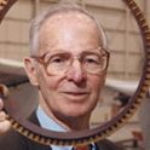
Paul MacCready
#12,293
Most Influential Person Now
American aeronautical engineer
Paul MacCready's Degrees
- Masters Physics California Institute of Technology
Why Is Paul MacCready Influential?
(Suggest an Edit or Addition)According to Wikipedia, Paul B. MacCready Jr. was an American aeronautical engineer. He was the founder of AeroVironment and the designer of the human-powered aircraft that won the first Kremer prize. He devoted his life to developing more efficient transportation vehicles that could "do more with less".
Paul MacCready's Published Works
Number of citations in a given year to any of this author's works
Total number of citations to an author for the works they published in a given year. This highlights publication of the most important work(s) by the author
Published Works
- Standardization of Gustiness Values from Aircraft (1964) (99)
- Structure of Atmospheric Turbulence. (1953) (68)
- Mean Wind Speed Measurements in Turbulence (1966) (54)
- Sun-powered aircraft designs (1983) (53)
- Response Characteristics and Meteorological Utilization of Propeller and Vane Wind Sensors (1964) (42)
- The inertial subrange of atmospheric turbulence (1962) (38)
- Turbulence measurements by sailplane (1962) (29)
- Development of a Wing-Flapping Flying Replica of the Largest Pterosaur (1985) (25)
- Observations of hydrometeor charge evolution in thunderstorms (1965) (25)
- Continuous Particle Sampler (1964) (24)
- LESSONS OF SUNRAYCER (1989) (21)
- Aircraft Vortex Wake Descent and Decay under Real Atmospheric Effects (1973) (19)
- Comparison of Some Balloon Techniques (1965) (17)
- An Assessment of Dominant Mechanisms in Vortex-Wake Decay (1971) (16)
- REGENERATIVE BATTERY-AUGMENTED SOARING (1999) (14)
- ATMOSPHERIC TURBULENCE MEASUREMENTS AND ANALYSIS (1953) (13)
- Precipitation Initiation Mechanisms and Droplet Characteristics of Some Convective Cloud Cores (1968) (11)
- The Case for Battery Electric Vehicles (2004) (9)
- OPERATIONAL APPLICATION OF A UNIVERSAL TURBULENCE MEASURING SYSTEM (1966) (9)
- dynamic response characteristics of meteorological sensors (1965) (9)
- The Great Pterodactyl Project (1985) (9)
- An Isolated Cumulus Cloud Modification Project (1969) (8)
- Flight on 0.33 horsepower - The Gossamer Condor (1978) (8)
- SUBCUTANEOUS EMPHYSEMA FOLLOWING TONSILLECTOMY: Report of Two Cases (1935) (8)
- XXI Inner Ear Deafness from Tetanus Antitoxin Injection (1938) (8)
- HIGH AND LOW ELEVATIONS AS THERMAL SOURCE REGIONS (1955) (7)
- Self‐charging of melting ice (1965) (6)
- CARDIOSPASM: REPORT OF TWO CASES WITH POSTMORTEM OBSERVATIONS (1935) (6)
- Turbulent energy measurements by vanes (1964) (5)
- Cloud Buoyancy Increase due to Seeding (1967) (5)
- Results of Cloud Seeding in Central Arizona, Winter 1951 * (1952) (5)
- Investigation of the Motion and Decay of the Vortex Wake of a Light Twin-Engine Aircraft (1974) (4)
- Mission Concepts Utilizing Gliders for Atmospheric and Surface Science (1999) (4)
- THE CASE FOR BATTERY ELECTRIC VEHICLES. IN: THE HYDROGEN ENERGY TRANSITION: MOVING TOWARD THE POST PETROLEUM AGE IN TRANSPORTATION (2004) (4)
- The Glaciation of an AgI-Seeded Cumulus Cloud (1968) (4)
- Of birds, bees, and airplanes: Technology can take lessons from nature on how to produce flying machines (1987) (3)
- LVI. So-Called Aneurysm of the Ascending Pharyngeal Artery: Report of One Case Which Developed under Observation (1935) (3)
- Bionic Bat - Stored energy human powered aircraft (1985) (3)
- VI Our Changing Conception of Acute Laryngotracheobronchitis (1944) (3)
- Observations of hydrometeor charge evolution in thunderstorms: Self-charging of melting ice (1966) (2)
- Aerodynamics and Other Efficiencies in Transporting Goods (2004) (2)
- Theoretical Considerations in Instrument Design (1970) (2)
- The Munitalp Cloud Theodolite (1957) (2)
- Doppler acoustic sounding: observational inputs to pollutant-dispersion models. Final report (1982) (1)
- Natural and artificial flying machines (1988) (1)
- Perspectives and Prejudices about Some Major Issues (1995) (1)
- Mixing Ratio Indicator (1965) (1)
- VERTICAL DIFFUSION FROM A LOW ALTITUDE LINE SOURCE. DALLAR TOWER STUDIES. VOLUME 1 (1961) (1)
- UNUSUAL MYXOMA OF THE PHARYNX: Report of Case in Which the Growth Developed Under Observation (1935) (1)
- INSTRUMENTS AND TECHNIQUES FOR LOCATING AND EXPLOITING THERMALS (1971) (1)
- CONTINUOUS PARTICLE SAMPLER STUDY PROGRAM (1963) (1)
- Investigation of atmospheric turbulence (1952) (1)
- Our changing concepts in the treatment of chronic ear disease. (1958) (0)
- Thirteenth Biennial Conference on the Physics of Estuaries and Coastal Seas (PECS), Astoria, Oregon, USA, September 2006. (2009) (0)
- APPLICATION TO DISPERSION MODELING (1984) (0)
- Contemplating the Unexpected (1992) (0)
- STUDY AND MODIFICATION OF CONVECTIVE STORMS. PART B (1964) (0)
- Conduction deafness in children; a study of 400 children, ages 3 to 12 years. (1952) (0)
- Interview with Paul B. MacCready (2006) (0)
- Cloud Seeding--A New Technology (1951) (0)
- Observations of buoyant plumes with monostatic acoustic radar (1976) (0)
- FORECASTING BOUNDARY LAYER TURBULENCE FROM SYNOPTIC METEOROLOGICAL DATA. Final Report. (1963) (0)
- VEHICLE EFFICIENCY AND THE ELECTRIC OPTION (1993) (0)
- Technology, in Perspective and under Control (1987) (0)
- Arizona Weather Modification Research Program (1970) (0)
- Conversations. With Paul MacCready. Interview by J.R.Wilson. (2003) (0)
- Aircraft and method for display control solar cells to light (2001) (0)
- Aeronef stratospherique a hydrogene liquide (2001) (0)
- BILATERAL PARALYSIS OF THE ADDUCTORS OF THE VOCAL CORDS OF ORGANIC ORIGIN: REPORT OF A CASE OF LANDRY'S PARALYSIS (1926) (0)
- Chronic ear disease. (1959) (0)
- Doppler Acoustic Sounding: Application to Dispersion Modeling (1984) (0)
- ANALYSIS OF FLAGSTAFF DATA. (1965) (0)
- THE HUMAN MOTOR: ORDINARY PEOPLE DOING EXTRAORDINARY THINGS (1980) (0)
- FLAGSTAFF CUMULUS STUDIES (1964) (0)
This paper list is powered by the following services:

Other Resources About Paul MacCready
What Schools Are Affiliated With Paul MacCready?
Paul MacCready is affiliated with the following schools:
