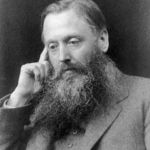
William Henry Young
#16,113
Most Influential Person Across History
English mathematician
William Henry Young's AcademicInfluence.com Rankings
William Henry Youngmathematics Degrees

Mathematics
#997
Historical Rank
Measure Theory
#260
Historical Rank

Download Badge
Mathematics
Why Is William Henry Young Influential?
(Suggest an Edit or Addition)According to Wikipedia, William Henry Young FRS was an English mathematician. Young was educated at City of London School and Peterhouse, Cambridge. He worked on measure theory, Fourier series, differential calculus, amongst other fields, and made contributions to the study of functions of several complex variables. He was the husband of Grace Chisholm Young, with whom he authored and co-authored 214 papers and 4 books. Two of their children became professional mathematicians . Young's Theorem was named after him.
William Henry Young's Published Works
Number of citations in a given year to any of this author's works
Total number of citations to an author for the works they published in a given year. This highlights publication of the most important work(s) by the author
Published Works
- Lectures On The General Theory Of Integral Functions (532)
- On Classes of Summable Functions and their Fourier Series (1912) (223)
- On the Fourier Series of Bounded Functions (112)
- On the Multiplication of Successions of Fourier Constants (1912) (91)
- On a Certain Series of Fourier (49)
- On Multiple Integration by Parts and the Second Theorem of the Mean (47)
- On The Integration of Fourier Series (46)
- On the Determination of the Summability of a Function by Means of its Fourier Constants (39)
- On the Mode of Oscillation of a Fourier Series and of its Allied Series (23)
- A theorem in the theory of fonctions of a real variable (1907) (22)
- On Integration with Respect to a Function of Bounded Variation (20)
- On multiple integrals (1917) (18)
- On the Discontinuties of Monotone Functions of Several Variables (18)
- On a New Method in the Theory of Integration (18)
- On Restricted Fourier Series and the Convergence of Power Series (18)
- On the Connexion Between Legendre Series and Fourier Series (17)
- On the General Theory of Integration (16)
- On the Ordinary Convergence of Restricted Fourier Series (1917) (15)
- On Successions with Subsequences Converging to an Integral (15)
- The Progress of Mathematical Analysis in the Twentieth Century (13)
- IX.—On the Conditions for the Reversibility of the Order of Partial Differentiation (12)
- On the Triangulation Method of Defining the Area of a Surface (10)
- On Integrals and Derivates with Respect to a Function (10)
- A Note on the Property of Being a Differential Coefficient (9)
- On Functions and their Associated Sets of Points (9)
- On Upper and Lower Integration (8)
- On Multiple Fourier Series (7)
- On the Analytical Basis of Non-Euclidian Geometry (7)
- On a Formula for an Area (7)
- On Implicit Functions and Their Differentials (6)
- On the Convergence of the Derived Series of Fourier Series (6)
- The fundamental theorems of the differential calculus (6)
- On Non‐Absolutely Convergent, not Necessarily Continuous, Integrals (5)
- On Systems of One-Vectors in Space of n Dimensions (1897) (5)
- On Indeterminate Forms (5)
- The Theory of Sets of Points: INDEX OF PROPER NAMES (5)
- On the New Theory of Integration (1913) (5)
- On a Class of Parametric Integrals and Their Application in the Theory of Fourier Series (1911) (4)
- Oscillating Successions of Continuous Functions (4)
- On the area of surfaces (1919) (4)
- On Fourier Series and Functions of Bounded Variation (1913) (4)
- Cambridge Tracts in Mathematics and Mathematical Physics. No. 11. The Fundamental Theorems of the Differential Calculus (1911) (4)
- On the Convergence of a Fourier Series and of its Allied Series (4)
- On the Existence of a Differential Coefficient (4)
- On the Discontinuities of a Function of One or More Real Variables (4)
- On The Internal Structure of a Set of Points in Space of any Number of dimensions (3)
- On Flat-Space Coordinates (1898) (3)
- On a New Set of Conditions for a Formula for an Area (3)
- Open Sets and the Theory of Content (3)
- On the Order of Magnitude of the Coefficients of a Fourier Series (1917) (3)
- Integration over the Area of a Curve and Transformation of the Variables in a Multiple Integral (3)
- On Non‐Uniform Convergence and Term‐by‐Term Integration of Series (3)
- On Semi‐Integrals and Oscillating Successions of Functions (3)
- A note on sets of overlapping intervals (1906) (2)
- On the Cesàro convergence of restricted Fourier series (1918) (2)
- The mathematical method and its limitations (2)
- On the Usual Convergence of a Class of Trigonometrical Series (2)
- On the Conditions that a Trigonometrical Series Should have the Fourier Form (2)
- On Series of Bessel Functions (2)
- On the Fundamental Theorem in the theory of Functions of a Complex Variable (2)
- On the Theory of Functions of two Complex Variables (2)
- On a condition that a trigonometrical series should have a certain form (1913) (2)
- On the Distribution of the Points of Uniform Convergence of a Series of Functions (1)
- On non-harmonic trigonometrical series (1)
- A note on the theory of the first variation in the calculus of variations (1910) (1)
- On the Density of Linear Sets of Points (1901) (1)
- On parametric integration (1910) (1)
- On Trigonometrical Series Whose Cesaro Partial Summations Oscillate Finitely (1913) (1)
- On the Null Space of a One‐System and its Associated Complexes (1898) (1)
- On the convergence of certain series involving the fourier constants of a function (1912) (1)
- Sets of Intervals on the Straight Line (1902) (1)
- On Uniform and Non-Uniform Convergence and Divergence of a Series of Continuous Functions and the Distinction of Right and Left (1)
- On the mode of approach to zero of the coefficients of a Fourier series (1917) (1)
- On Non‐Harmonic Fourier Series (1)
- On the Reduction of Sets of Intervals (1)
- On the curve $y = {\frac{1}{{x}^{2}\,+\,\text{sin}^{2}\,\psi}}^{\frac{3}{2}}$, and its connection with an Astronomical Problem. (1897) (1)
- On the Nature of the Successions formed by the Coefficients of a Fourier Series (0)
- Note on the Existence of Converging Sequences in Certain Oscillating Successions of Functions (1916) (0)
- On Term-by-Term Integration of Oscillating Series (0)
- Ordinary Inner Limiting Sets in the Plane or Higher Space (0)
- On the Theory of the Application of Expansions to Definite Integrals (0)
- On change of the independent variables in a multiple integral (1919) (0)
- On the formation of usually convergent Fourier series (1913) (0)
- On the Fundamental Theorem of Integration for Multiple Integrals (0)
- On a test for non–uniform convergence (1904) (0)
- On the Fourier constants of a function (1911) (0)
- On Closed Sets of Points defined as the Limit of a Sequence of Closed Sets of Points (1902) (0)
- On the transformation of integrals (1921) (0)
- On Uniform Oscillation of the First and Second Kind (0)
- On a mode of generating fourier series (1911) (0)
- Linear Content of a Plane Set of Points (0)
- On Closed Sets of Points and Cantor's Numbers (0)
- The Tile Theorem (0)
- The General Theory of Integration. (0)
- XV.—On a Test for Continuity.. (0)
- On the series of Legendre (1918) (0)
- On the Inherently Crystalline Structure of a Function of any Number of Variables (0)
- XLI.—On Sommerfeld's Form of Fourier's Repeated Integrals. (0)
- On the Uniform Approach of a Continuous Function to its Limit (0)
- Note on Functions of Upper and Lower Type (0)
- On Sequences of Sets of Intervals Containing a Given Set of Points (0)
- On Successions of Integrals and Fourier Series (0)
- On Derivates and their Primitive Functions (0)
- XL.—On Fourier's Repeated Integral. (0)
- On Stokes's Theorem (0)
- On Homogeneous Oscillation of Successions of Functions (0)
- On the Fundamental Theorem of Differential Equations (1901) (0)
- On the Determination of a Semi-Continuous Function from a Countable Set of Values (0)
- The Introduction of the Mathematical Idea of Infinity (1907) (0)
- On the Inequalities Connecting the Double and Repeated Upper and Lower Integrals of a Function of two Variables (0)
This paper list is powered by the following services:

Other Resources About William Henry Young
What Schools Are Affiliated With William Henry Young?
William Henry Young is affiliated with the following schools:
